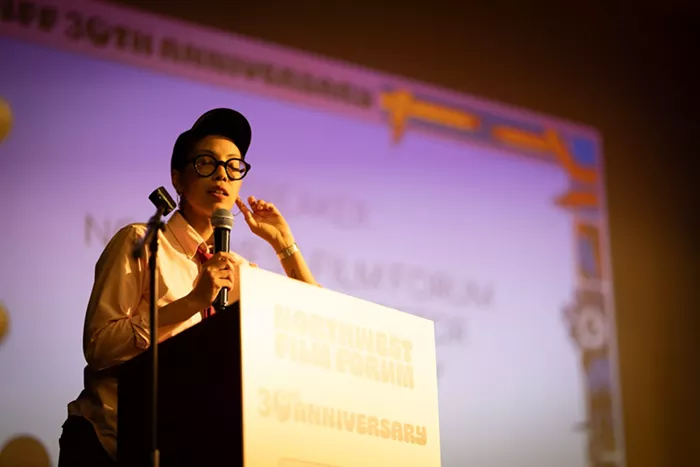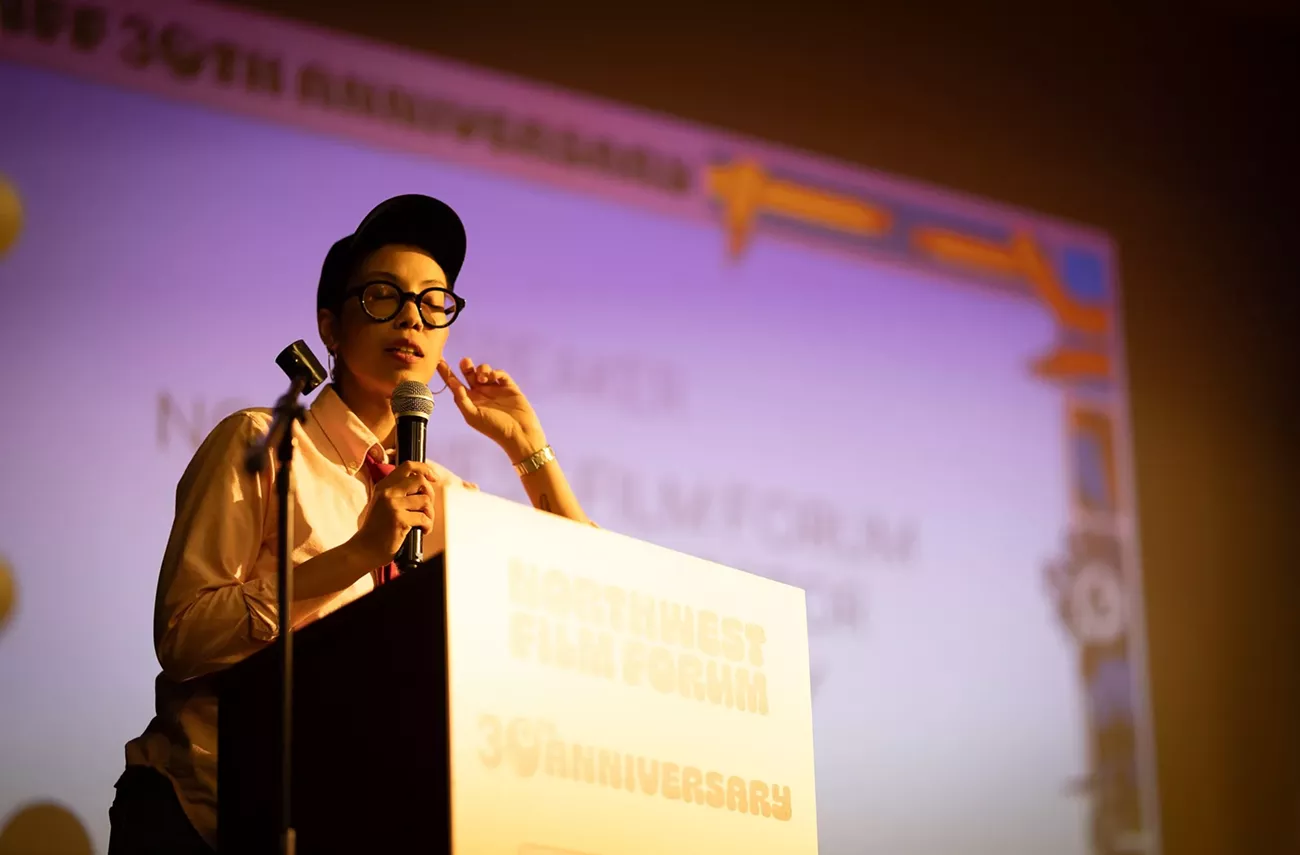
Jill Busby, the interim executive director at Northwest Film Forum (NWFF), is dropping the “interim” from her title and stepping into the role full-time. She wants to restore the film nonprofit to the bustling cultural center it once was.
She’ll be the fourth executive director to try in the last decade. Busby, a multidisciplinary writer and artist, says her “brain began to tingle with possibilities” shortly after she took over from previous executive director Derek Edamura, who stepped down last October.
“I felt ready to step up in this moment especially after seeing us through so many hard moments and recovery points,” Busby says in an interview with The Stranger. “I don’t ever want to see us in a situation again, even in chaotic times, where we have to lose someone because we aren’t in a sustainable moment.”
The hard moment she’s referring to came in 2024, when the organization laid off nearly half of its staff to keep its programming from tumbling off the edge of a sheer financial cliff. What type of programming? Year round, NWFF teaches filmmaking workshops and screens the type of unique films you won’t see anywhere else, such as the fascinating The Mysterious Gaze of the Flamingo, a strikingly shot queer drama set in 1980s Chile that made a splash at Cannes, which opens this week.
It’s tough out there for independent theaters and film orgs, and NWFF isn’t the only one struggling. The magnitudes-larger SIFF, with its three theaters and annual film festival, has laid off round after round of employees in the last year and left the beloved Egyptian to dust while attempting to make their marquee purchase of the SIFF Cinema Downtown (formerly known as the Cinerama) work.
Busby seemed optimistic that the worst was behind NWFF. Grants and enthusiastic donors have come through, and audiences are returning to its theaters. Busby specifically shouted out her org’s partnership with the volunteer-run Seattle Film Society. On the last Thursday of the month, the group hosts “Locals Only” at NWFF, a showcase of local films, such as in January when they screened shorts by James Andrews, Bryon Donaldson, Nicole Olson, and Derek Nunn.
Providing that space is essential to making NWFF a hub like it used to be, Busby says. It was at NWFF that the late, great director Lynn Shelton saw the French auteur Claire Denis, who made her first movie at 40, in 2003, and realized there was still time for her to make movies, too. Think about that—without NWFF, we might not have Humpday, Your Sister's Sister, Outside In, or Sword of Trust. We might not have Barry Jenkins’s Moonlight, either. He screened some of his earliest work, including Medicine for Melancholy, at the forum.
“For me, it’s the perfect embodiment of what an independent film organization can do to empower a filmmaking community,” Jenkins said in 2009. “You can go and see movies that you wouldn’t normally get to see because they don’t screen at your local multiplex, but also, in the same building, I have access to equipment or you can learn how to make the same kind of films that you see on those same screens.”
The forum’s still connected to the talents it nurtured. Busby intends to lean on board members like Megan Griffiths, the longtime local filmmaker and SIFF staple, who brought in actor/director Jay Duplass to collaborate on the session “How to Make Movies in the Apocalypse” last year.
Busby also wants to hear from us. The forum is launching a free, community-curated festival this year. Anyone who donates $50 or more can nominate any film that’s graced its screens in its more than 30-year history.
“In such hard times, people really do rediscover how much community is important to them,” Busby says. “I think we will see more and more people return to that third space, that hub, and we’ll be there.”
But aren’t they always saying the children are our future? Busby wants to grow, and diversify, NWFF’s youth summer camps. SIFF cut its youth summer camps this year. It’s a gap NWFF can fill, but not completely. Fill a balloon too much, too fast, and it pops. It takes serious money to expand programming, the kind only grants and rich donors can provide. Busby first wants to rebuild, rehiring positions cut in the dark days of 2024 (by the end of next month, she expects to hire one part-time and one full-time position) and spending grant funds on a new development director.
“You can’t grow before you have found a way to be sustainable. Staying small for as long as we have to,” Busby says. “We have remained strong and we’re not doing more than what we can actually do.”