“Seattle has better Chinese food than New York, anyway,” Xian Zhang quips from the couch in her new office, overlooking Second Avenue. “Well, in New York, it’s mainly Cantonese food. But I find Chinese food from the north actually better here. I’m from the north, so I like the handmade dumplings and hand-pulled noodles, that kind of thing. Seattle does it better.”
Before she even landed, word was already on the street that the Seattle Symphony’s new music director is a massive foodie. Sure enough, it’s only a few minutes before she’s comparing our restaurants to those in her home of the last decade.
Zhang is still pulling double duty between Seattle and the New Jersey Symphony, where she’s been the resident music director since 2016. “My son, it’s his junior year,” she explains, “and it’s too late for him to change schools, so he’s finishing high school there. I don’t wanna mess up his life!” But since accepting a five-year contract in Seattle last year, she admits, she’s been feeling a little more at ease out here.
“I grew up in a climate just like this—cold, a little humid and windy,” Zhang says, motioning toward the window. “And we had lots of shellfish,” she grins, bringing it back to food. “That’s my thing—my favorite! So Seattle is perfect for me, actually.”
It’s mutual, babe. Scoring Zhang is a monumental win for Seattle, and not only for her enormous talent and fiery vivacity. Alongside having no music director at all following Thomas Dausgaard’s sudden email ragequit in 2020, the Seattle Symphony’s had 17 conductors in its 123 years, and they all looked more or less the same—white and presumed male—until Zhang. It brings a li’l tear to the eye of this former Cornish piano major, who could only find one female American conductor to look up to in the late ’90s (the legendary Marin Alsop). Down around Benaroya Hall, when you see all the colorful media paraphernalia heralding Zhang’s arrival—there are vinyl stickers glued to the actual sidewalk, reading XIAN!—it seems like overkill at first. But then you’re like: You know what? Let them cook. This is the Seattle Symphony’s Cinderella moment.
Even today, the game’s still heavily dominated by men in the United States, with women and nonbinary people making up just 29.4 percent of American symphony conductors. It’s much worse outside the US, with a 2023 study reporting that just 11.2 percent of conductors are women worldwide. As well, 66.9 percent of American symphony conductors are white. No figures are currently available on how many of the remaining 33.1 percent are female or non-male, but one can imagine it’s a slender slice. There’s Zhang and there’s Alsop, who’s the laureate director of the Baltimore Symphony, and the Atlanta Symphony has Nathalie Stutzmann at the wheel. But when it comes to symphonies in major American cities, these three women pretty much make up the whole scene.
“There also just aren’t that many of us conductors,” Zhang points out, “women or men. It’s a numbers problem. Because it’s a hard job! Not so many people can do it.”
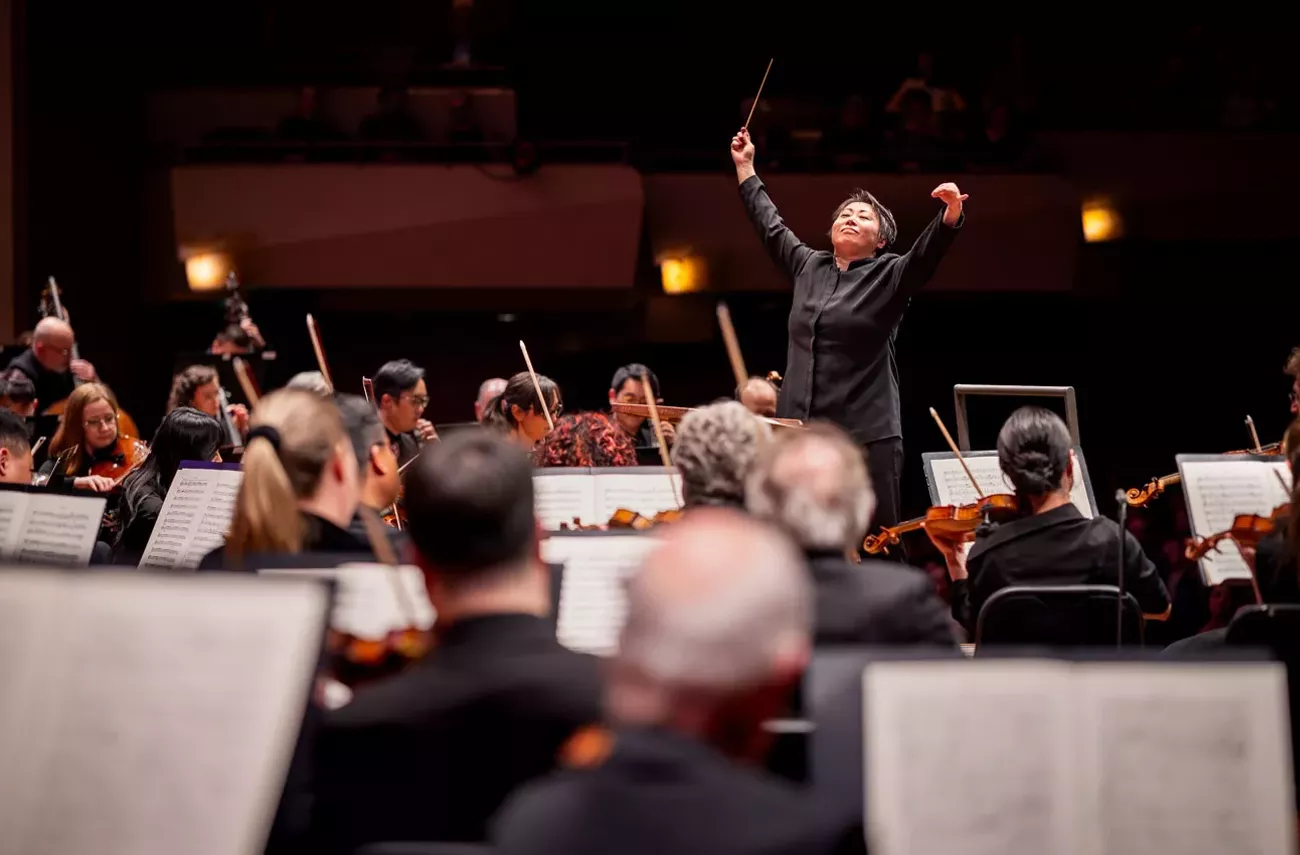
She said a mouthful there, because to watch this woman conduct an orchestra is electric. Armed with her baton, this mini maestra seems 10 feet tall, commanding her musical battalion with real joy and absolute authority. Even from the nosebleed seats, you can feel the crackle in the air. Few people can do that job, indeed.
Xian Zhang (“sh-yen jahng”) was born in 1973 in Dandong, near the North Korean border, to a music teacher mom and a luthier dad. When Western instruments were scarce in Cultural Revolution-era China, her father built a piano for her from scratch. She began piano lessons at age 3 and was practicing eight hours a day by elementary school. At 11, she was sent to the Central Conservatory of Music in Beijing to study piano performance under Lingfen Wu, herself a pioneering female conductor.
Zhang was dropped into conducting somewhat against her will when, one day, Wu sent her 20-year-old student to sub at a rehearsal at the China National Opera. “I’d just finished learning The Marriage of Figaro from her—but I’d never conducted anything in my life! It was a four-and-a-half-hour production, with professional musicians. My teacher called in the day before and said, ‘Um, I don’t feel well, but I’m gonna send my student to conduct tomorrow. If she does a bad job at rehearsal, I will try to come in at intermission and take over.’
“The director of the opera was very mad at my teacher that morning,” Zhang laughs. “‘How can you do this to us? And send a little girl?’ I was very short, very tiny. I remember sitting on the bus with the other musicians going to the opera house, thinking, I’m gonna DIE today. I’m gonna mess this up and be so embarrassed, and I will die.” But she did it anyway, and when her teacher called at intermission to check in, she was told, “Well, she actually seems to be doing okay? She’s almost done with the second act.”
“And my teacher was like ‘Uh, okay, I still don’t feel good! Let her finish the show.’ The next day, she kept saying she was sick. So yeah, she gave me two shows with the China National Opera when I was 20. That was my first public conducting job.”
Zhang didn’t forget it, and today, she goes out of her way to pay it forward and support female orchestral musicians, along with those from other underrepresented groups. She points to a recent Benaroya performance of composer Michael Abels’s Delights and Dances performed by laureate winners of the Sphinx Competition, which is open to young Black and Latino string players in Detroit and endeavors to address systemic obstacles within their communities. “The quartet was all students who’d won a competition for young, less-privileged players. I really, really feel strongly about supporting this kind of program.”
Since leaving China in 1998 to pursue her doctorate in Cincinnati, Zhang’s led orchestras in Milan, Montréal, Amsterdam, Melbourne, Cardiff, Singapore, London, and dozens of US cities. As well as back home in Beijing—in addition to her current roles in Seattle and New Jersey, she’s also the principal guest conductor at the China National Opera this season. True to brand, only a month after her introductory gala at Benaroya Hall in September, she jetted off to Helsinki for the rest of 2025, where she’d already signed up to conduct Tosca before saying yes to Seattle.
Now that she’s picked the reins back up in Seattle, Zhang is super pumped for the production of Iris Unveiled (originally Iris dévoilée), playing February 12, 14, and 15. In a Peking opera-style concert suite that Zhang says is very special to her personally, Chinese-born French composer Qigang Chen mashes up Chinese stringed instruments like the pipa and erhu with a Western-style orchestra, as solo vocalists sing in both Western and Chinese operatic styles. The suite describes the story of Iris, the Greek goddess of the rainbow, employing texture and color to describe various facets of divine femininity: coyness, jealousy, voluptuousness, lust. As the central figure, soprano Meng Meng wears traditional Chinese makeup and a kuitou (头), an elaborate headdress loaded with pearls and tassels and pompoms.
The production’s timing is pinned to the Lunar New Year and the Seattle Symphony’s second annual Lunar New Year Gala. Benaroya Hall’s lobby will be decked out for the holiday, tickets include a multi-course authentic Chinese dinner, and there’ll be performances by select artists from Iris Unveiled’s cast. “I’m so excited, yes!” Zhang says. “The story is based on old Chinese poems, and there’s some really authentic Chinese art involved in the program. And I find the music just strikingly beautiful.” The show, she adds, will be a great way for her to begin engaging with the Asian community here in Seattle, as a fresh start for the new year.
Zhang isn’t new to Seattle, for what it’s worth, having first guest-conducted the Seattle Symphony in 2008. “I’ve always liked Seattle! To me, Seattle has come up as one of the most vibrant cities in America nowadays. I like the people. They’re different from the East Coast—slightly laid-back, and they’re not as edgy. And also, I like the diversity of the community. I feel comfortable here, you know, as an Asian person.
“And I like the food here too!” she says, splitting off to enthusiastically recommend a hot pot restaurant off Aurora. “It’s like a shabu-shabu place. I know the name in Chinese but not in English!” She goes on to rave about the meat combo, as passionately as she spoke about Iris Unveiled. After playing 20 Questions, we realize it’s No.9 Alley Hot Pot in Bitter Lake.
Despite our rep as one of the nation’s most progressive cities, Seattle’s classical music scene has been kind of a musty old ghost ship over the last few years, with nobody at the helm. So it’s sincerely thrilling to see the fiery, sizzling energy that Zhang brings on board. Right out of the gate, she’s going out of her way to platform women, POC, and other underrepresented musicians, along with youth orchestras, local composers, and hell, the restaurant scene, too. Seattle’s classical community has needed this delicious zap in the butt since 1903. No amount of vinyl sidewalk stickers with her name on them is enough.